Hi everyone. It’s time for the
Moline Media Minute. Here’s a sampling of things I’ve watched and read lately:
Out of the Silent Planet by CS LewisKind of a disappointment. I love the
Chronicles of Narnia, and this book is the first in Lewis’s adult-oriented Space Trilogy. Unfortunately, I had to slog through it. Though, to be fair, I’m not much of a classics kind of guy; I don’t usually enjoy the style.
Dr. Ransom is kidnapped by a mad scientist and his assistant and taken to another planet (which turns out to be Mars) with the intention of being sacrificed to gain favor with the foreign inhabitants. Once there, Ransom escapes his captors and integrates with the different species and societies he meets. Eventually he comes face-to-face with the ruler of the planet who mets out justice to all three humans as he sees fit.

Critics raved about Lewis’s entire trilogy back in the 70s when it was written, but I found his first one rather tedious at times.
I loved the ideas behind the book and the overall philosophy, theology, and mysticism of Lewis’s Mars compared to Earth (“The Silent Planet”). He had great characters, too. But the dense descriptions and slow pace made it difficult for the book to hold my attention.
The Wicker ManThis was
Nicholas Cage’s suspense thriller about a secluded island and its strange, Amish-type community. When Cage’s ex-fiance contacts him about her missing daughter (whom she fears is about to be harmed by the island’s community), Cage races to the rescue.

I was excited to see this movie. I’m not a big Nicolas Cage fan, but I’m all about the weird mystery-thriller genre. Unfortunately, the ending was a big let down, and as you know ... it’s all about the ending for me.
I was completely engrossed in the movie, but the finale, meant to be shocking and horrendous when it finally answers your questions, ultimately disappoints when the plot sucks all life and hope from its characters.
What a waste. What a downer. No wonder it bombed at the box office.
The Road to Cana by Anne RiceWow. She did it again. Anne Rice sure knows how to take a gamble and make a masterpiece.
Beginning with some bare bones information from the Gospels, Rice creates a story about
Jesus’ life before He began His ministry, adeptly weaving history, family, geography, politics, spirituality, and humanity into an engaging and powerful novel.

And she takes risks.
This time around, Rice begins her story with two young boys - accused of homosexual activity - being stoned to death by the citizens of Nazareth (Jesus’ hometown) and ends the book with Jesus’ baptism in the Jordan, His exorcism of Mary Magdalene (here Mary of Magdala), and His forty days of temptation in the desert (handled ingeniously, I thought).
If you’re a fan of
Chaim Potok’s novels of Jewish life (and even if you're not), you’ll enjoy Rice’s take on Biblical Jewish society. I’m definitely looking forward to Anne Rice’s next book.
CompanyMy friend,
Brian, was so kind to have kept the Broadway Revival Presentation of
Stephen Sondheim's Company (shown on PBS last year) on his DVR for months and months for me until we were finally able to get together and watch it. He personally didn’t care for the production, and I wasn’t sure what to expect but ... overall, I liked it.
I definitely think watching the show on television doesn’t carry the same weight or impact of watching the live performance (obviously, but sometimes it
does work, like MTV’s showing of
Legally Blonde). This version of
Company was so modern and minimalistic, I think it needs the atmosphere and energy of actually being present with the actors.
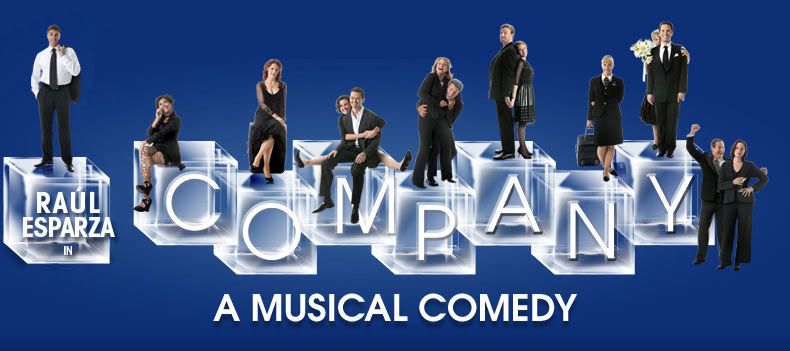
However, I still thought it was a powerful production. Having all the actors play their own instruments actually worked for once. I never saw the
Sweeney Todd revival, but I can’t imagine how that would be successful and not distract from the musical. But here, the actors interact and socialize through the music, and their instruments practically become characters in their own right.
I didn’t care much for the melancholy undercurrents, though. Sondheim describes Company as being difficult for audiences to grasp due to its ambivalence:
relationships are impossible, yet we can’t live without them. However, there’s an overall negativity to the show that he doesn’t appear to recognize. The musical’s theme is a paradox, but the lack of hope and positivity affects that audience’s ability to connect with the material.
Still, I still enjoyed this critically-acclaimed revival and was glad to finally see it. Sondheim is a musical theater genius, and this show was no exception.


 . I always have. Read them over and over and over throughout my life-time.